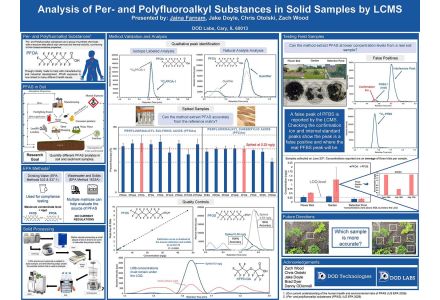
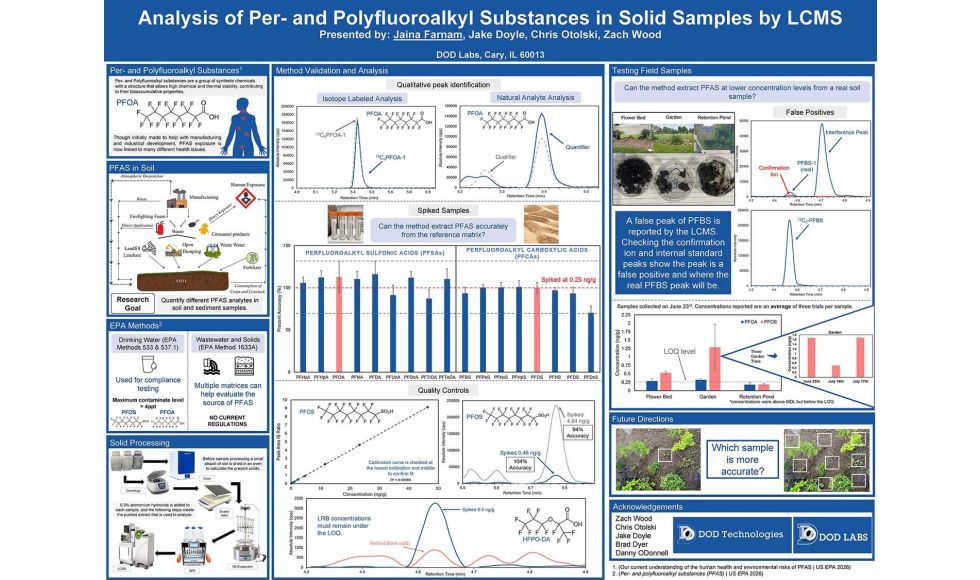
[Click the image above to view a higher quality verison of the poster.]
There's a decent chance the soil under your flower bed contains trace amounts of chemicals that never fully break down. That's the unsettling premise behind a research poster presented by DOD Labs intern Jaina Farnam — and it's an impressive showcase for a college freshman's first summer in an analytical lab.
A Freshman Takes on Forever Chemicals
Jaina just wrapped up her freshman year at LSU, where she's working toward a BS in biochemistry with a minor in honors research. This summer, she joined the analytical team at DOD Labs in Cary, IL, with a specific mission: help validate soil and biosolids analysis under EPA Method 1633A — the government's playbook for detecting per- and polyfluoroalkyl substances (PFAS) in solid matrices.
It's no small task to hand a first-year student. But by the end of the summer, Jaina had run method validation experiments, tested real-world soil samples, and put together a poster that traces the entire arc of what it takes to reliably detect PFAS in the ground beneath our feet.
What Are PFAS, and Why Does This Matter?
PFAS are a family of synthetic chemicals engineered for a very specific purpose: they don't break down. Their molecular structure gives them extraordinary chemical and thermal stability, which made them incredibly useful across decades of manufacturing and industrial applications. The catch is that the same stability that makes them useful also makes them bioaccumulative — they build up in living tissue rather than degrading.
That durability has earned PFAS the nickname "forever chemicals." While they were originally developed to make life easier (think non-stick cookware, waterproof fabrics, firefighting foam), PFAS exposure is now linked to a range of human health issues — and it can move from soil into the crops and livestock we eventually eat.
The Regulatory Gap Jaina Helped Address
The EPA has well-established methods (533 and 537.1) for testing PFAS in drinking water, complete with a maximum contaminant level of just 4 parts per trillion for compounds like PFOA and PFOS. Solid matrices like soil and biosolids, however, fall under EPA Method 1633A — a method that can be applied across multiple matrices to help trace where PFAS is actually coming from. That's the work Jaina spent her summer doing.
Learning the Method, Step by Step
Over the course of the summer, Jaina learned to extract and concentrate PFAS from soil samples, quantify them using an extracted internal standard method, and calculate both method detection limits (MDLs) and limits of quantification (LOQ) — the key values of any trace-chemical method.
She also got hands-on experience with the full suite of quality controls baked into EPA Method 1633A, from confirming there was no contamination introduced during sample processing to verifying proper instrument calibration every single day. Notably, her percent recovery of PFAS at the method's LOQ landed comfortably within EPA Method 1633A's specified limits — a strong indicator of careful, precise sample preparation.
Catching False Signals
One of the sharpest parts of Jaina's summer work involved learning to distinguish a real PFAS signal from an impostor. While testing real-world soil, she encountered interfering signals in all three of her local soil samples. Rather than taking those signals at face value, she used the quality controls embedded in EPA Method 1633A to determine that the interferences were not actual PFAS analytes — a good reminder that in trace-level chemical analysis, a peak on a chromatogram isn't proof of anything until you've ruled out the impostors.
What the Real Soil Samples Showed
Jaina closed out her summer by analyzing three local soil samples in triplicate, sourced from a variety of locations. She was able to quantify both PFOA and PFOS above the method's LOQ of 0.25 ng/g in two of the three samples — real, measurable detections in ordinary soil.
One of the two samples with PFOS told a different, equally valuable story. It proved difficult to homogenize, and triplicate extractions from the same sample bottle produced a notably high relative standard deviation (%RSD) between results. Jaina concluded that this variability stemmed from the inherent inhomogeneity of some soil samples — no amount of mixing before extraction can fully even out how PFAS is distributed throughout a sample, which means concentrations can genuinely vary day-to-day. It's a finding with a practical takeaway: anyone sampling a large area for PFAS contamination should consult their testing lab on the best sampling strategy to get a truly representative picture, rather than relying on a single grab sample.
The Takeaway
In one summer, Jaina went from freshman biochemistry student to someone who can validate an EPA method, troubleshoot false positives, and draw real conclusions about sampling strategy from her own data — the kind of experience that turns a lab job into the start of a career. DOD Labs is thankful to have hosted her this summer, and we're excited to see where her studies take her next.
For more information about soil/biosolid or other PFAS-related testing, please contact DOD Labs at https://dodlabs.com/contact or call us at 815-788-5200.