Per- and polyfluoroalkyl substances — PFAS — have earned the nickname "forever chemicals" for good reason. Their carbon-fluorine bonds are among the strongest in organic chemistry, which is exactly why they resist breakdown in the environment and in the human body. But "forever" doesn't mean "untouchable." Across drinking water systems, industrial sites, landfills, and firefighting foam-contaminated soils, remediation teams are making real progress — and none of it works without rigorous analytical testing at every step.
Testing isn't just a regulatory checkbox. It's the instrument panel that tells remediation teams what they're dealing with, whether their methods are working, and when a site can finally be called clean.
Why PFAS Testing Is Uniquely Hard
Unlike many contaminants, PFAS isn't one chemical — it's a family of thousands of related compounds, many of which behave differently in soil, water, and air. Detection limits for regulated PFAS are often in the parts-per-trillion range, meaning labs are hunting for a few molecules in what amounts to an Olympic swimming pool of water. Add to that the fact that some PFAS precursors transform into more persistent "terminal" compounds like PFOA and PFOS after they've been released, and you have a moving target that requires specialized equipment and evolving methods just to see clearly.
The Analytical Toolkit
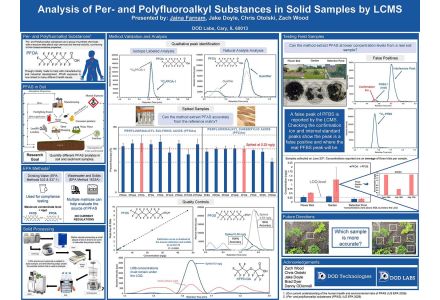
Environmental labs - such as DOD Labs - rely on a handful of standardized methods, most built around liquid chromatography paired with tandem mass spectrometry (LC-MS/MS):
- Targeted methods (such as EPA Methods 537.1, 533, and 1633) quantify a defined list of PFAS compounds — typically 18 to 40 — at trace concentrations across water, soil, biosolids, and other media. These are the workhorses for regulatory compliance and cleanup verification.
- Ultra-short-chain PFAS testing targets compounds with three or fewer carbons (like TFA and PFPrA) that are highly mobile and persistent but fall outside standard EPA methods
- Total oxidizable precursor (TOP) assays chemically convert unknown PFAS precursors into measurable terminal compounds, revealing contamination that targeted methods alone would miss.
- Non-targeted screening methods cast a much wider net, flagging thousands of PFAS-related signatures even when a specific compound isn't on a standard list — useful for characterizing unusual industrial sites or unknown source areas.
EPA finalized Method 1633 for PFAS in wastewater, surface water, soil, and other environmental media, and companion screening method 1621, giving labs and dischargers a more consistent national basis for reporting under Clean Water Act permitting programs.
Where Testing Fits Into the Remediation Lifecycle
1. Site characterization. Before anyone can remediate anything, they need to know where the PFAS is, how much is present, and how it's moving through soil and groundwater. This drives every downstream decision — from remedy selection to cost estimates.
2. Remedy selection and design. Different remediation technologies — granular activated carbon, ion exchange resins, foam fractionation, in-situ stabilization — perform differently against different PFAS chain lengths and precursor loads. Analytical data tells engineers which technology fits the contamination profile at hand, rather than guessing.
3. Performance monitoring. Once a remediation system is running, ongoing sampling confirms it's actually removing PFAS at the expected rate. Breakthrough in a carbon filter, for instance, shows up in the lab data long before it would be obvious any other way.
4. Destruction verification. This is where testing becomes most critical — and most scrutinized. When PFAS-laden waste (used filter media, foam concentrate, contaminated soil) goes to destruction, testing is what confirms the PFAS didn't just move somewhere else. EPA's evolving destruction and disposal guidance ranks technologies partly based on how well they've been shown, through testing, to fully break down PFAS rather than releasing products of incomplete combustion or transforming compounds into other persistent byproducts. EPA's most recent interim guidance identifies underground injection, hazardous waste landfilling, and thermal treatment under specific high-temperature conditions as the options with the lowest demonstrated release potential — with incineration's ranking improving as newer combustion research addressed some of the earlier uncertainty, even as the agency notes open questions remain about incomplete combustion at lower-temperature facilities.
5. Closure and long-term stewardship. Confirmation sampling determines whether a site meets cleanup standards, and periodic monitoring afterward ensures contamination doesn't rebound — particularly important given how easily PFAS can migrate through groundwater over long timeframes.
A Moving Regulatory Target
Testing requirements aren't static. Method 1633 and its companion screening method are being folded into Clean Water Act permitting frameworks, which will standardize how dischargers report PFAS going forward. At the same time, drinking water compliance timelines for PFOA and PFOS have shifted, even as the underlying 4 parts-per-trillion limits remain in place — which keeps liability exposure very real for site owners even as some deadlines move. Meanwhile, states aren't waiting: several are building their own soil cleanup standards and public-facing testing dashboards, and dozens now regulate PFAS-containing firefighting foam directly. For anyone managing a contaminated site, that patchwork means testing protocols increasingly have to satisfy multiple overlapping jurisdictions, not just a single federal standard.
The Bigger Picture
None of the remediation and destruction technologies making headlines — advanced oxidation, supercritical water oxidation, mechanochemical destruction, high-temperature incineration — mean much without the analytical chemistry to prove they work. Testing is what turns "we destroyed the PFAS" from a claim into a demonstrated fact, sample by sample, compound by compound. As detection methods get more sensitive and destruction technologies mature side by side, that feedback loop between the lab bench and the field is what will ultimately determine how quickly contaminated sites — and the communities around them — get clean.
For additional information or assistance with your PFAS lab-based testing needs, please contact DOD Labs at 815-788-5200 or reach out to us at https://dodlabs.com/contact.
DOD Labs is a fully accredited NELAC (TNI) and ISO/IEC 17025 environmental PFAS testing laboratory. This post reflects the regulatory and technical landscape as of mid-2026; PFAS rules and guidance continue to evolve, so always confirm current requirements with EPA and relevant state agencies before making compliance decisions.